Tits et al. | Meisen et al.
|
Unlike puritan US-American people I am not afraid of tits – nor are my children or my wife – which is a rather good thing, because otherwise she would scream any moment she sees one ...!
|
Each winter we feed our songbirds. The family and myself truely enjoy watching them chirping and floating around and
I take pictures through the windows sometimes. The condition of our windows is partly responsible for the blurryness of some pictures below. It's not enough to make me clean them though ...
|
 |
Where we live, we get most often the Great Tit (Kohlmeise, Parus major) and the Blue Tit (see below) at the feeders. These two species also like to nest in the many bird houses we hung up. Without distracting from their beauty it can be said that they are pretty common over here.
|
|
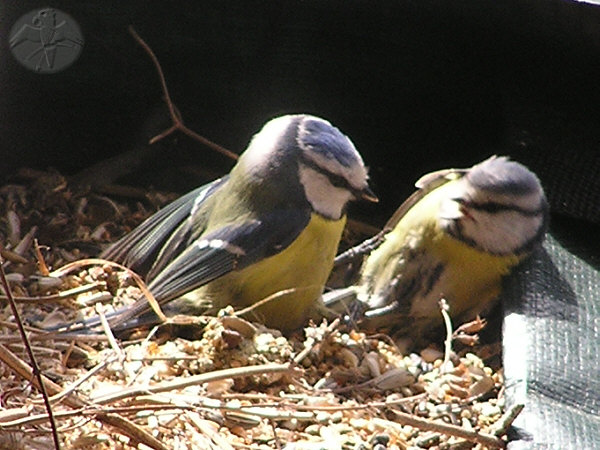
These two Blue Tits (Blaumeise, Parus caeruleus) had a good fight above some left over seeds from my Parrot, who had been sitting around on the terrace (the seeds, not the Parrot) together with other organic trash, waiting for lazy Falk to carry them away ...
|
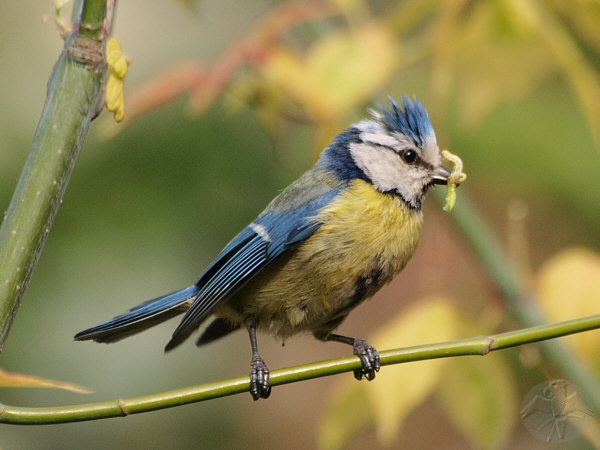 |
The Blue Tit (Blaumeise, Parus caeruleus) at left is going to feed its chickens – behind a board IN our front door! The whole thing is chirping now! A crazy spot for building a nest for sure ...
|
 |
Some other Tits are most obvious in the midst of the winter, when greater numbers come down from Scandinavia, the Baltics or Russia, to evade the even harsher climate up north and east. One of the cutest little Tit must be the tiny but Long-tailed Tit (Schwanzmeise, Aegithalos caudatus). Their tender fluteing sounds, short little beak, long tail and often up-side-down position far out on the branches, are always a delight to hear and see.
|
 |
Always close to the conifer trees in the woods at the village we have the Coal Tit (Tannenmeise, Parus ater). The dull black hood and the big black patch below the beak are obvious. They also show some white feathers in the top neck region, which are good for determination.
|
 |
The Crested Tit (Haubenmeise, Parus cristatus) is not that numerous over here. But if you know where to look, you may discover her at coniferous trees, searching for seeds etc. She seems to prefer Pine over Spruce, as I only have the later around the house and very seldom see her in my garden. But in the pine trees just 200m away, there she is ...
The pic shows the almost uncropped original frame; I consider this one of my better (i.e. lucky) shots.
{9} [600mm, F7.1, 1/320s]
|
 |
The Marsh Tit (Sumpfmeise, Parus palustris) stays in the woods and was rarely seen at my feeders – until recently. Now I am enjoying a pair of Marsh Tits visiting the garden and feeders every day.
{12} [600mm, F6.3, 1/200s]
Almost identical colored and thus easily confused with the Marsh Tit is the Willow Tit (Weidenmeise, Parus montanus).
It's scarce at my place, so I have no decent pic yet.
|
 |
We got to see the Nuthatch (Kleiber, Sitta europaea) in the garden once in a while, all year round. He is more interested in the old trees and what can be discovered there, then in our feeders per se. They do breed regularly in artifical houses, hung up in the bushes aside the village – and prefer to stay over there in the first place. Always on the move and most times high up in a tree, they are hard to photograph at all. It took me quite some time and new optics, to be able to show this picture. The Nuthatch is associated with Tits, so I place him here. In fact, its old but more or less obsolet German name is "Spechtmeise" – which translates to 'Woodpecker Tit' (for some Woodpeckers scroll down).
|
 |
Update 2010:
Not in 5 years time have I seen a Nuthatch at my feeders. Well, this year is different! Early in autumn I errected some simple feeders which offer seeds unprotected from the elements. There you have it! Two Nuthatches are constantly coming in and carry Sunflower seeds away. Best of all, they aren't to disturbed, if I stand only steps away! Weather permitting, this should offer me some great photos in the future – with no need to shoot through the window as was the custom.
{11} [340mm, F4.7, 1/200s]
|
 |
In this photo you can examine the proportions of a Nuthatch's foot, especially the last toe (equiv. to thumb). It's obviously not made for "groundwork" but highly specialised in size and shape for climbing.
{11} [400mm, F5.6, 1/400s]
|
Okay – I've got to extend this special Tit site for a bit more birding experiences. There wont be more Tits, but eventually other lovely sights ...?!
|
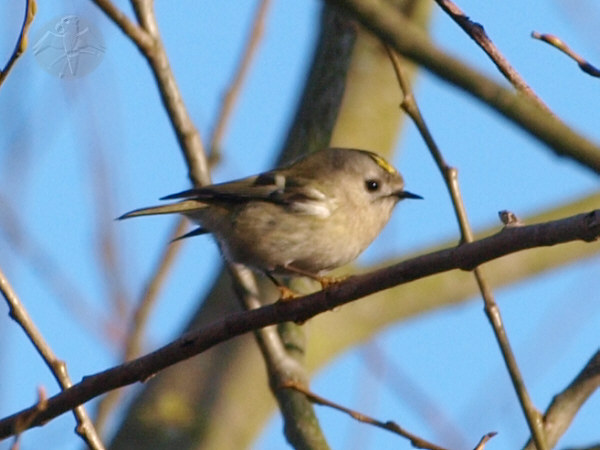 |
Our smallest bird is the Goldcrest (Wintergoldhähnchen, Regulus regulus). With a total weight of only 80 grains, they not even get close to that of a standard field point! These tiny fellows are quite often guests in our spruce trees and I think they actually nest there in summer too. Today I photographed a Goldcrest hen (yellow cap vs. orange in males) when she moved from one spruce to an other, but took a short rest in a willow (see above).
|
 |
Beside our Tits flocks of Sparrows (Hausspatz, Passer domesticus) visit the feeders most often. They'll patrol them all in the neighbourhood and can have a devastating effect on the seed supply, within minutes. I don't care as I really do like them a lot! The picture shows a male House Sparrow, females are all brownish.
|
 |
This pic shows a Tree Sparrow (Feldspatz, Passer montanus), were botch genders are equally colored. Notice the dark cheeks to tell them appart from male House Sparrows; also the beak tends to be dull black, not always the case though.
|
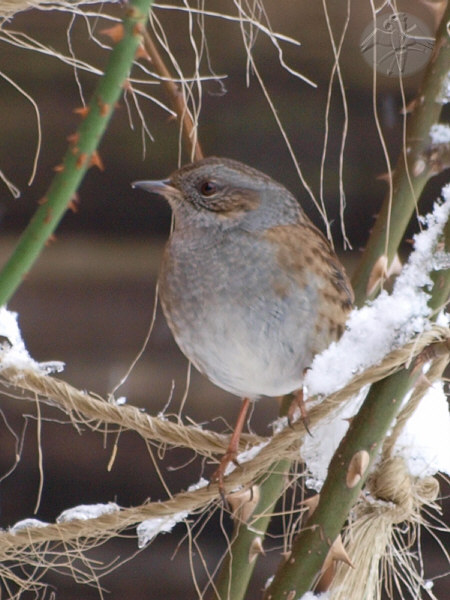 |
On first sight the Dunnock (Heckenbraunelle, Prunella modularis) can be confused with a Sparrow, but then you discover its small beak and its grey tint. It's also called "Hedge Sparrow" because of the similarities, but I suggest not to use this name, as it will only support existing confusions. Only at our feeder when everything is covered deep in snow – as it is now!
|

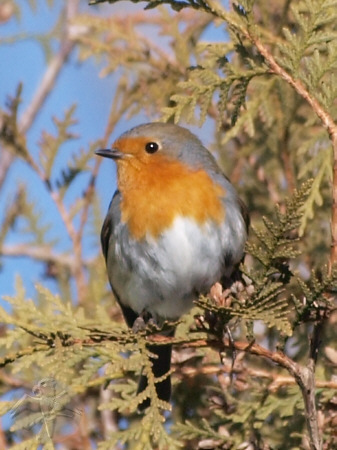
The Robin (Rotkehlchen, Erithacus rubecula) is a rather shy fellow but hangs around the whole day and will wait for his turn to catch his share. Two or three of them are always in the vicinity.
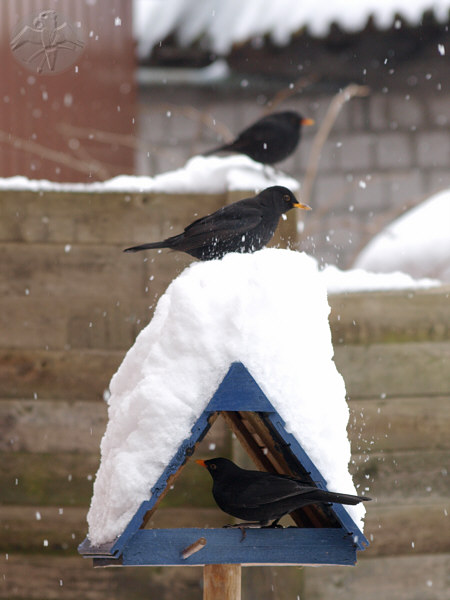

The Blackbird (Amsel, Turdus merula) is the ruler at the feeder. It's rather a pest as far as the Tits are concerned, because it will sit at or in the feeder, only to prevent others from geeting their chare. One only has to look at the first picture, which says it all! However, the males orange beak and sharply contrasting midnight black feathers, provide a spot of color in our generaly dull, wet, cold and depressing winter times – so they do get away with their bad manners. BTW: the dark brown females are generally worse then the males ...
|
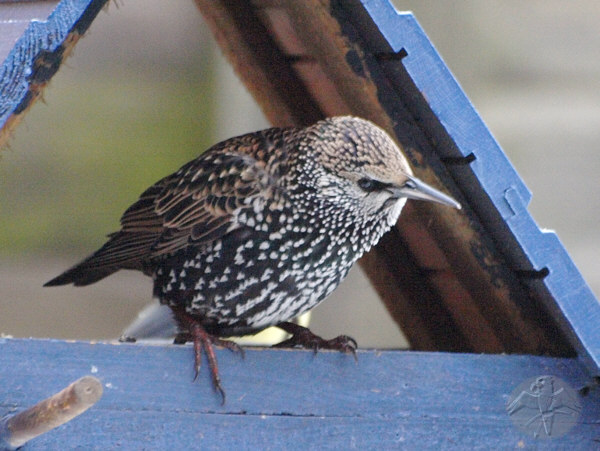 |
Very seldom a Starling (Sturnus vulgaris) can be watched at our feeder. They do breed at the house and are so common from spring till autumn, that I not even cared to picture them then (I need to change that). They should head down to the Mediterranian in winter, but it seems as if not every bird knows about it, as I had them here in January! The photo above was snapped in mid winter with temps way below freezing point. It shows the bird in his winter colors. They'll change for more shiny black mating colors in spring.
|
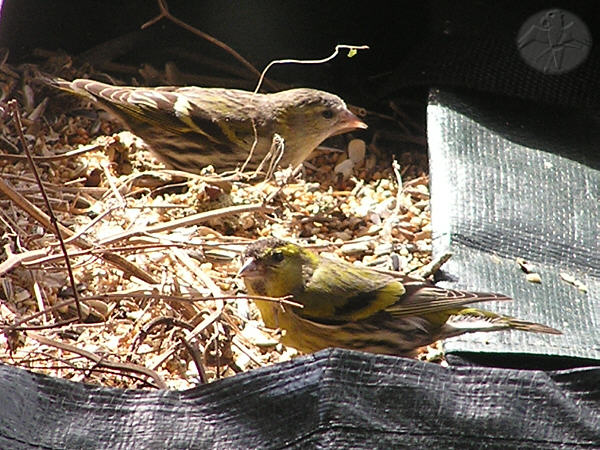 |
These Siskins (f above, m in front; Erlenzeisig, Spinus spinus) are a rather rare sight at my place, especially when seen just in front of the window, as in this case.
|
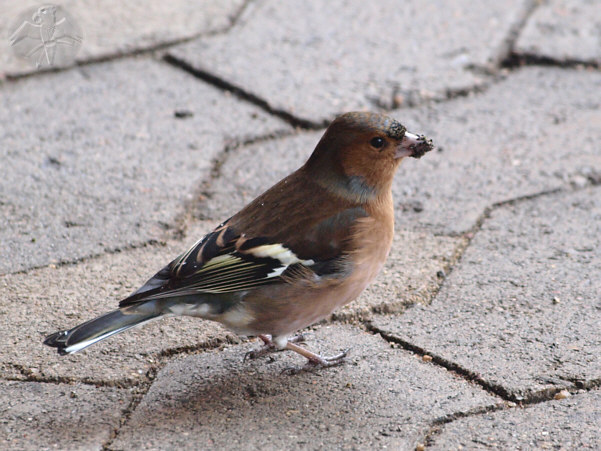 |
The Chaffinch (Buchfink, Fringilla coelebs) stays with us throughout the year but only takes on the feeders when a good layer of snow makes it really hard to get at some natural seeds. Depicted is a male Chaffinch which has reddish cheeks and a blue-grey neck and head, which allows us to tell him appart from the female.
|
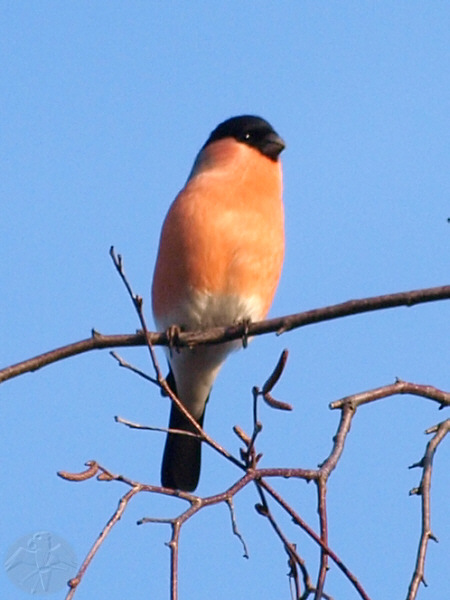
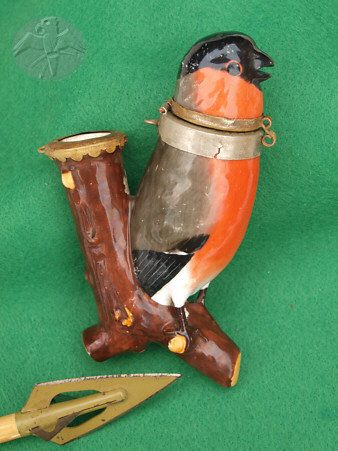
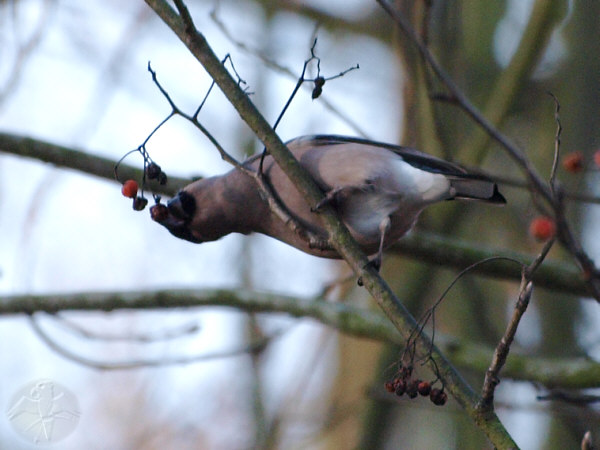
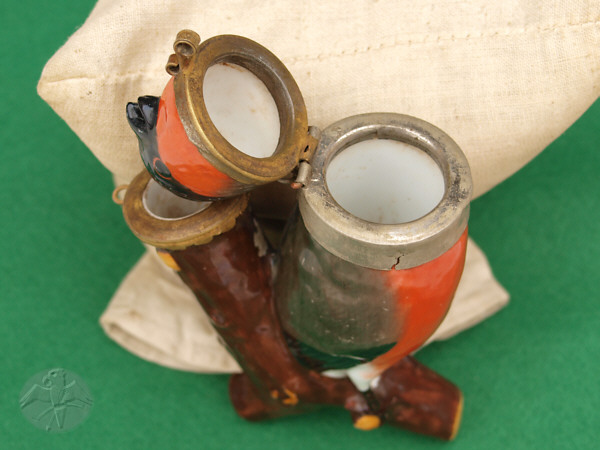
A male Bullfinch top left and a female bottom left (Gimpel oder Dompfaff, Pyrrhula pyrrhula ). These too will come down in numbers from the far north during the winter, to escape cold and starvation. Especially the males neat color is true eye candy in our generally grey and trist winter and together with their tender voice the Bullfinches are an asset to our woods. The females show a brownish grey breast (not tits).
To the right we have a vintage Ornithologist Club members porcelain tobacco pipe from probably 1830-50. It shows different grades of silver fittings but unfortunately lacks the original mouth piece. I soaked it in water for several years (!) to be able to drain out the stinky old tobacco sauces, which had accumulated in the hollow trunk and branches. I will reinstall a mouth piece of my own make and liking, polish the silver just little and this should be a great smoking conversation piece – again!
|
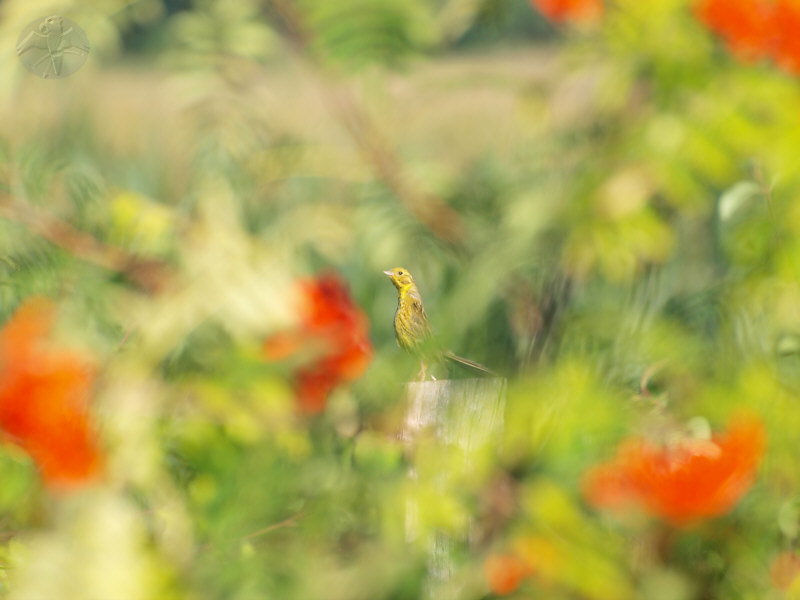 |
This Yellowhammer (Goldammer, Emberiza citrinella) was resting on a fencepost on the other side of a hedge row. I had a hard time to find a hole suitable to get any picture of her; I tried several and my efforts didn't went unnoticed – as can be seen quite clearly. This is a full frame with no cropping done, because I just love the blur and colors in this photo.
|
 |
The Blue-headed Wagtail (Motacilla flava, Schafstelze); nothing special to tell about other then I like its colors and that its not so very common as the White Wagtail (Motacilla alba, Bachstelze) which I've not even pictured yet.
{6} [600mm, F7.1, 1/800s] |
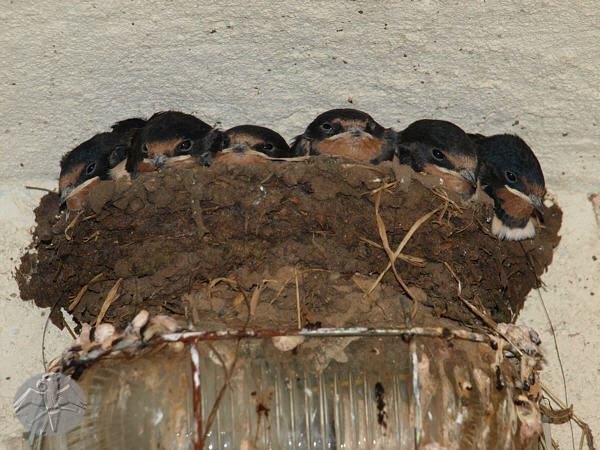 |
We have at least one nest of Swallows (Rauchschwalben, Hirundo rustica) in the horse stables every year. The chicks in this photo are almost done and would by now like to perch more on the rim of the nest for a bit more space to each other. But with me fondling the camera infront of them, they tried to retreat – with barely a chance though 
{7} [300mm, F8, 1/180s, flash] |
 |
These freshman aviators (Rauchschwalben, Hirundo rustica) were begging for fuel with no mercy! The parents flew in every two minutes and stuffed one or two at a time – hovering almost always – and quickly went of again, hour after hour! To bad the light was so miserable this day ...
{6} [190mm, F4, 1/400s] |
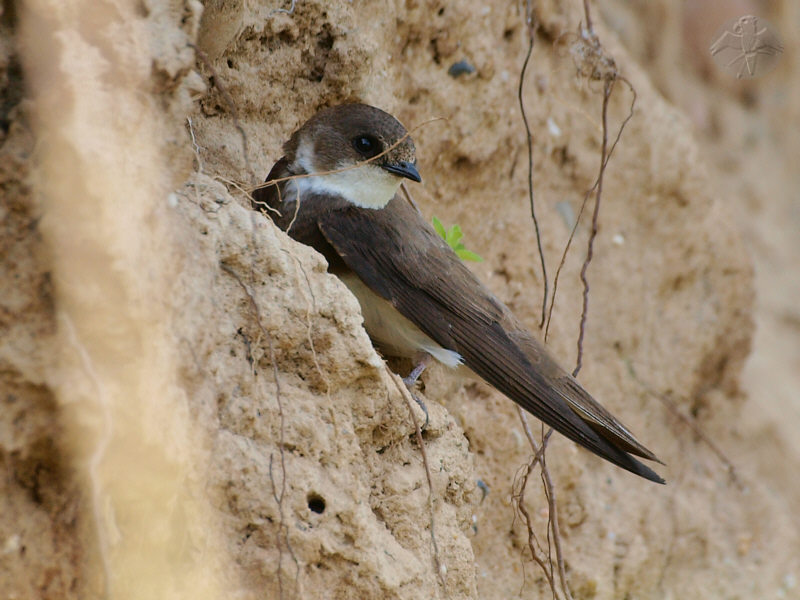 |
The Sand Martin (Uferschwalbe, Riparia riparia) is an endangered species where I live. Far to many natural escarpments along rivers or lakes are leveled or grown over completely, because the river was "tamed" and wont carve into its levees any more. Thus the Sand Martin has nowhere to dig its burrows into. These birds were known for their habit to build large colonies – well – the photo shows one bird of a single pair, which nests in a former gravel pit close by.
{7} [600mm, F8, 1/200s]
|
|
Woodpeckers are always nice to see, but other then Maurice Thompson, I have no intention to shoot them out of the trees or elsewhere. Our largest bird of the family is the Black Woodpecker (Schwarzspecht, Dryocopus martius). I see and hear him quite regularly. Next in size would be the Green Woodpecker, which I see sometimes but it is a rare bird – not the least due to his specialisation to devor mostly ants. Since our Wood Ant (Waldameise, Formica rufa) is fully protected and 'nature evironmentalists' like to 'protect' every ant hill with chicken wire domes, they may do the ants a favor but have cut the food supply for the Green Woodpecker short and certainly helped to made him alsmost extinct. Wise chaps, aren't they?!
The Grey-headed Woodpecker (Grauspecht, Picus canus) is quite similar to the Green Woodpecker but I am not certain I have ever positvely identified one in the fields so far.
|
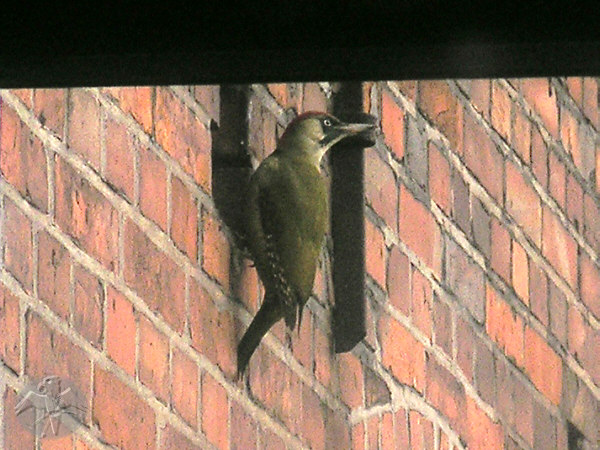 |
Green Woodpecker (Grünspecht, Picus viridis) in November and very low light conditions at the wall, just outside my window (dark area atop is the roof of the terrace). This is a true snap shoot! I had barely enough time to grap the camera, switch power on and take the shot, before the bird was gone again. I had to really pull the colors in postprocessing here, as the photo was way underexposed. But please imagine the woodpeckers hood more a bright red and the green a tud greener.
|
 |
Our most common is the Great Spotted Woodpecker (Buntspecht, Picoides major). I see or hear him more or less on daily basis – but this is not to say I have good photo material of this bird, as you can see left. In general they are a little to far away or high up the tree, or obscured by branches or, more often, it is just to dimm to get away with shutter speeds suitable for anything close to a sharp picture. The pic at left shows a Great Spotted Woodpecker male, easily determined by the red band on his neck. Taken on a dull winters day, with the low standing sun behind the Apple tree.
|
 |
This Great Spotted Woodpecker (Buntspecht, Picoides major) female is about to feed her chicks, waiting in an old Plum tree (see below). The female can be destinguished from the male, because she does not show any red on her head at all. Note the amber coloured band on the forehead, a feature shown in both genders, but easily missed and confused with white (see male above).
|
 |
This juvenile Great Spotted Woodpecker (Buntspecht, Picoides major) is looking out of his den in an old Plum tree. Mother woodpecker is about to feed him (see above), so he shows up at the opening to get his share and speed up the process. Note that in juvenile Greater Spotted Woodpeckers both sexes show a red coloured cap, but the red band at the neck is not yet present in young males.
|
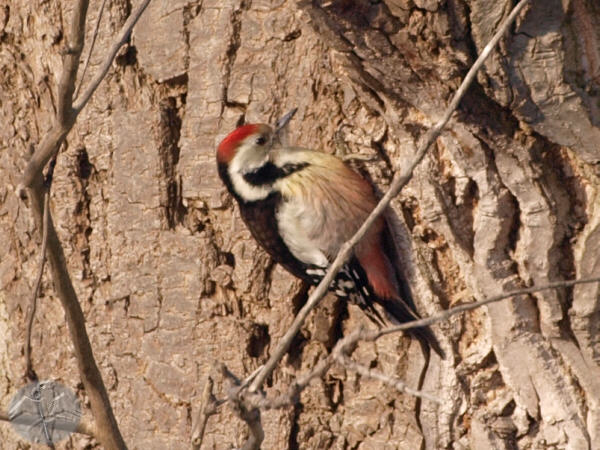 |
A little smaller and with an extended cap in bright red, is the Middle Spotted Woodpecker (Mittelspecht, Picoides medius). He is somehow prettier then the Great Spotted Woodpecker, but is unfortunately more rare also.
|
 |
Our smallest is the Lesser Spotted Woodpecker (Kleinspecht, Picoides minor) and where I grew up I remember them to be not scarce. Where I am living now (not to far away from the former place) I have only seen and photographed one, so far. I guess this has more to do with the different times and less with the actual distance!?
The combined high-ISO snapshot photos at left were taken in the shade of tall beech trees, with cloud cover and at some distance. Though, the photos are pretty poor, we can see the striped back without any white spot covering the shoulder, as would be seen in Great and Middle Spotted Woodpeckers. The red forehead indicates the male, whereas the female would show an amber color only.
|
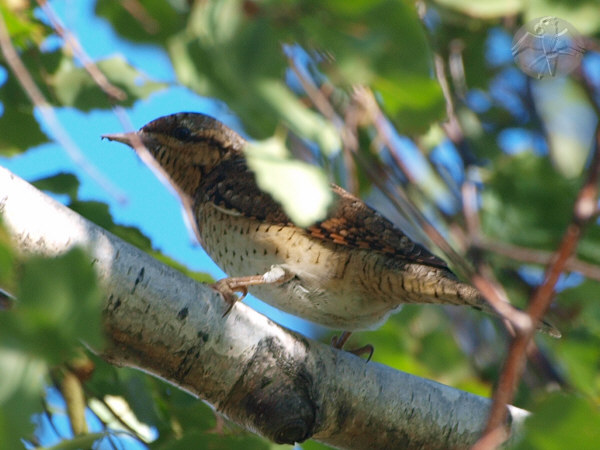 |
The Wryneck (Wendehals, Jynx torquilla) is in some respects similar to Woodpeckers but belongs to a different family.
It is a rare bird and I am glad that I can show a photo at all as I only got a single snapshot chance on him.
Somehow the scientific name reminds me of Douglas Adams and his marvelous Hitchhiker's Guide to the Galaxy! Sounds like an anagram of Gin Tonix – which term, as we now all know, is in the entire universe always designated to something to drink – from what kind of stuff it may ever be made of ... :-)
|
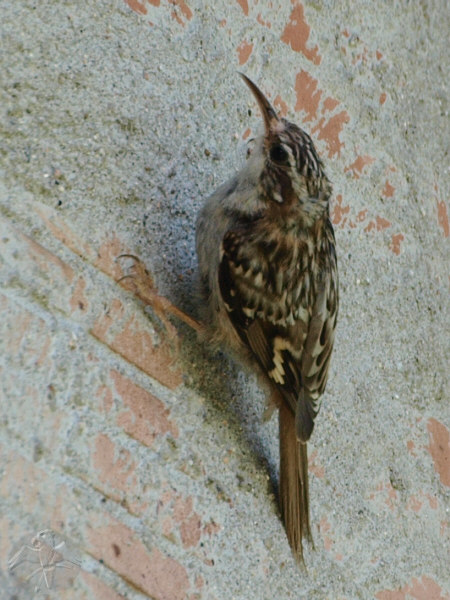 |
Our Short-Toed Tree Creeper (Gartenbaumläufer, Certhia brachydactyla) is no Woodpecker. Like the Nuthatch this little bird goes up and down the trees without paying attention to its own oriantation or to gravitation at all!? But versus the Nuthatch the Tree Creeper has the advantage of woodpecker-like stout tail feathers, to support him in uppright position. But I see him as often upside-down as vice versa. Little harder to spot due to good camo and hard to photograph because he is always on the move.
This particular bird build his nest in a gap in that brick wall he is climbing, just to the left of this frame ...
|
 |
The Tree Creeper (Waldbaumläufer, Certhia familiaris) is very similar to the Short-Toed Tree Creeper.
It shows a more silver white plumage on breast (not tit!) and flanks, has a slightly shorter beak and longer claws. The forehead is more spotted then in the former species; it is not as common at my place.
{3} [1000mm, F7.1, 1/250s]
|

The Barn Owls (Schleiereule, Tyto alba) in my neighbours barn. These are chicks, almost done, with bits of baby plumes left. The shot was taken at night from my garden, with the camera on a tripod and just a single LED-Headlamp for iluminating the scene! It's a two second high ISO exposure, but the Barn Owls did cooperate! As can be seen, our Barn Owl is the darker subtype Tyto alba guttata, not showing the clear white breast (not tit), of which the latin name originated.
{9} [430mm, F5.1, 2s]
|
 |
One of the Barn Owls (Schleiereule, Tyto alba) seen above "came in" for a CloseUp.
Few days after the above photo was taken, the young Barn Owls left their nest for first flight-trips. Our own barn standing in "direct flight-path" and offering lots of covered space and probably mice, naturally lends itsself as pearch- and resting place for the young Owls. There is one problem though: Our hay, straw and oats fed mice population is manged by our (ex tom-)cat: "Ozelot"
Young Barn Owls, which are still unfit and unsecure in flight are something he likes to play with and chase about! I catched the depicted Owl myself, after he had had a little fun with her. She had been still to dumb to find a way out or to get high enough into the attic – and that is where I put her into safety, after our photoshot!
|
 |
CloseUp of the talons of a Barn Owl (Schleiereule, Tyto alba). Photo taken from the same young specimen as seen above.
A lucky bird insofar, as she has not to wear a ring of any sorts. The Owl "protecting-people" missed this very late bred birds – and I was not going to tell them of their existence.
|
 |
Tawny Owl (Waldkauz, Strix aluco); at dusk sitting in a Larch tree, waiting for darkness;
{5} [555mm, F5.6, 1/60s]
|
 |
Tawny Owl (Waldkauz, Strix aluco).
I heard this guys charcteristic voice during several late summer nights, before he was brought to me by an neighbour one morning. It fell victim to yet an other complete insane law we have to face over here!
Since our administration went amok after the infamous "birds flu" was going to kill the population, every yard or place for domestic birds had to be fully covered by a roof or netting etc., to prevent wild birds getting inside and drop their deadly cargo → the man-eating, pandemic and totally desastrous H5N1-Virus!
Because I was not going to follow this nonsense I had to get rid of my own flock of chickens! But the neighbourhood bowed and covered their chicken runs. Finally it was such a law-enforced net in which this Tawny Owl got entangled, when trying to hunt mice in the chickens yard. Fortunately he was discovered in his misery, already hung up there for probably several hours. After he was rescued and a subsequent inspection by myself, he could be released unharmed.
{9} [50mm, F6.3, 1/60s, flash]
|
 |
The Buzzard (Mäusebussard, Buteo buteo) is very common. A quick look and appreciation and I move on; and for that reason it seems that I don't have adequate photos!?
Bussards are seen in all shades but two types dominate my place, dark brown as here, or with a pretty much white underside. In general the males tend to show more white then the females.
The neck and tail are short, wings are broad and well rounded; most often seen sailing in some thermal currents or sitting on fence posts.
{4} [600mm, F7.1, 1/800s]
|
 2nd Photo
|
Normally I do not react when I see a Buzzard (see above), just because they are so very common. A quick look and appreciation and I move on. But, as in this case, the quick look was enough so that I recognized here is something different to the silhouette. Then I just managed to alter some switches on my camera (because I was busy shooting CloseUps from Hobby Falcons, see below) so I could at least have a grab shot. Even though I had not enough time to get it all right, I am glad I tryed, because I only see one Honey Buzzard (Wespenbussard, Pernis apivorus) each or every seconds year – at the most – and had not yet a single photo of one!
Note his long neck and small head, also note the long Hawk-like tail; the markings on the wings underside are typical, but can be confused with similar ones in some Buzzards.
{8} [600mm, F6.3, 1/1250s]
|
 |
I have got two pairs of Marsh Harriers (Rohrweihe, Circus aeruginous) breeding within 1km distance from the house, so it can't be called rare. The females are dark brown with just a patch of beige colored feathers on head and neck.
{7} [600mm, F6.3, 1/800s]
|
 |
The grey winged males of Marsh Harriers (Rohrweihe, Circus aeruginous) are quite a bit smaller but more beautiful then the females. Their back is brown, but tail and vanes are grey; also note the black pinnions.
{6} [600mm, F6.3, 1/640s]
|
 |
The Red Kite (Rotmilan, 'Gabelweihe', Milvus milvus) is a large and pretty bird, which I always like to watch. Sometimes they fly below roof tops through the village, in search for food. The have adjusted to humans pretty well and there are about the same numbers present as with the common Buzzard. I really wonder, why it was ever marked as a more endangered species then the Black Kite in my literature ...!?!
{6} [300mm, F7.1, 1/250s]
|
 |
The Black Kite (Schwarzmilan, Milvus migrans) seems to be slowly recovering after at least a 30 year period of constant downcline. The Red Kite never had such problems. The shown bird is hovering right next to a crop harvester, in a cloud of dust. I show the pic anyways, as he is presenting his full underside so nicely.
|
 |
This Osprey (Fischadler, Pandion haliaetus) came along with a good sized Perch (Flußbarsch, Perca fluviatilis) already towed to his gear, after I'd waited some hours at the shores of the local lake, to get a decent shot of it. Of course I would have liked to picture it catching the fish, but no complains, I am pretty happy with the outcome. Because, it is not that you can just go out and watch an Osprey at leasure at my place, but, that's exactly what I had in mind when I went out that morning ...!
{9} [600mm, F6.3, 1/1000s]
|
 |
I spotted this Osprey (Pandion haliaetus) first, when I was actually searching for mushrooms around said lake. Weired thing is, last year, at the very same place, I did just that too – and had a mere second glimps of an Osprey, before trees got into the sight and I was distracted by a Phantom F-4, screaming overhead. Given the 'fact' that there are no Ospreys in our vicinity, I had (just) a little doubt, I had positive identified one. So, dear Osprey, thanks for coming back this year and making it clear ...
{9} [600mm, F7.1, 1/640s]
|
 |
The Sparrow Hawk (Sperber, Accipiter nisus) is an ellusiv bird, however, I managed to take this shot (and others) of a young male Sparrow Hawk in the early morning hours.
I assume, that many people have never seen one, at least not knowing what it was, when they actually did!?
Their fast and dashing flight needs to be known, then it's not that big of a problem to recognize it's characteristic shape and high wing flapping frequenzy – within a split second.
The Sparrow Hawk resambles the by far bigger Goshawk in appearence; this is especially true for the female. Young male birds actually show female colouring, but that will be quite different and more colorfull in adults (s.below).
{3} [600mm, F6.3, 1/250s]
|
 |
For some time now, I have the pleasure to watch the pictured Sparrowhawk (Sperber, Accipiter nisus) at left. But as usual, it is winter time, dull, rainy, misty and overall there is ± no light for any decent photos available. However, the record shot at left does show the above mentioned colours of the adult male Sparrowhawk, which is distinctively different from the females or young ones (s.above).
{1} [850mm, F8, 1/80s]
|
 |
The Goshawk (Habicht, Accipiter gentilis) is probably one of the most difficult raptors to approach and photograph in the wild. Their stealthy style of living and hunting does not suite well with getting them photographed at all. So I was fortunate to take this shot of a subadult female Goshawk in beginning mating season, when they tend to be more vocal then in the off season. After she gave some calls for the mature male, which I had seen gaining some altitude minutes before, I spotted her in 100m distance (thus a heavy crop). I was only allowed this record shot though.
Been grown up togehter with Goshawks, I recognize their silhouette with ease. I might see a Goshwak where others think they are not present at all ...
{3} [1000mm, F7.1, 1/200s]
|
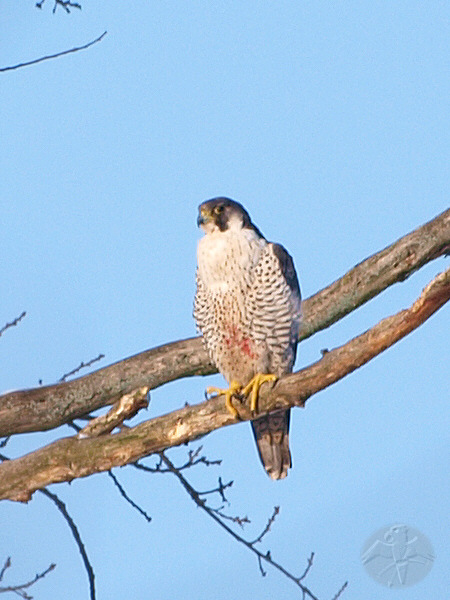
I am proud that I am able to include my namesake here, which I was fortunate enough not only to see but to photograph recently! Been grown up with falconry, I have no problem recognizing rare birds of prey on a glance. It works like a charm and in split seconds! I know it is triggered by the characteristic flying silhouette of birds, and I am quite happy I somehow own this ability, even though friends like to joke about it. For example once during a BBQ at my place, while everybody else was occupied with beer and steak, I had to point my finger skywards: "Look! Look! A Golden Eagle!" Those guys however – uninitiated – never even looked, because they thought I was going mad (again)! [On their part they can claim, that the sighting of an Golden Eagle in our vicinity can be counted by one hand, for several decades!] But they certainly missed the point, and their chance, this time, as I've seen the same (juv.) bird little later again!
The Peregrine Falcon (Wanderfalke, Falco peregrinus) shown above was located in harsh winter between my place and the mayor city close by. It's quite a big female and she obviously had just finished her meal when I saw her dodging some Crows, several hundred yards away. A look through my binocs convinced me of the fact, that I was to be a lucky chap, as the winter sun was shining and I had my camera + tele lens ready as well. She did me the favor of settling down in plain sight and allowed me to close in to about 100 yards, two times. Jackpot!
Peregrine Falcons would probably be extinct over here, if not for long time breeding projects, founded mainly by falconeers societies – such as the Deutsche Falkenorden – where my late father was a member of. My own sightings of wild birds, as here, are maybe about once every third year. And thats for: far away, dashing through the sky at full bore! So you might understand, why I am still so excited right now?!
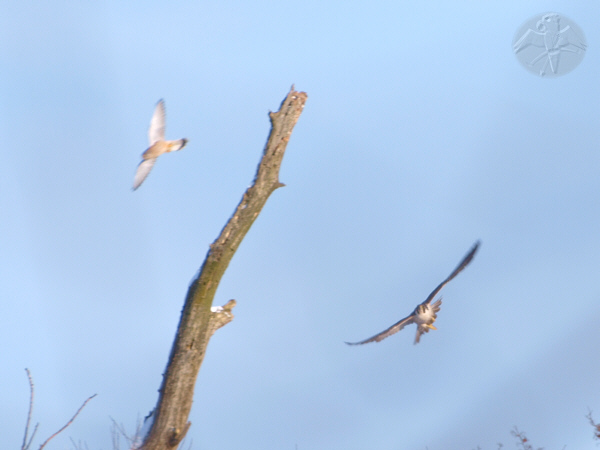
Having been annoyed by Crows and finally by a Kestrel (Turmfalke, Falco tinnunculus), the Peregrine took a final strike after the Kestrel (second pic) and left for good. Half an hour I will remember!
|

|
The Hobby Falcon (Baumfalke, Falco subbuteo) can be seen as the miniature resambling of the Peregrine, just so as the small Sparrow Hawk resambles the big Goshwak. I am delighted to have Hobby Falcons breeding in my vicinity quite regularily. The photo shows the female on her perch, high up on a large powerline pole/tower – or whatever it's called.
{7} [850mm, F8, 1/400s]
|

|
This is the male Hobby Falcon (Baumfalke, Falco subbuteo) flying overhead. He is always busy driving passing Birds of Prey or Raven and Crows, off of the nesting site. Or he is hunting for small birds and large insects, to feed his wife and chicks. But, if he dares to get home empty handed, I have seen the female chasing him fiercely :-) "Go and get us some food – Useless!"
{7} [850mm, F8, 1/500s]
|

|
I had a lot of concerns because of the miserable weather with lots of cold, rain and storm in our summer 2011. Therefor I am delighted to report, that 'my' pair of Hobbies managed to raise two young ones nevertheless! This is the juvenile male Hobby Falcon (Baumfalke, Falco subbuteo) a few days after leaving the nest.
{8} [600mm, F7.1, 1/250s]
|

|
I had a lot of concerns because of the miserable weather with lots of cold, rain and storm in our summer 2011. Therefor I am delighted to report, that 'my' pair of Hobbies managed to raise two young ones nevertheless! This is the juvenile female Hobby Falcon (Baumfalke, Falco subbuteo) a few days after leaving the nest.
{8} [600mm, F7.1, 1/320s]
|
 |
The adult male of the Red-backed Shrike (Rotrückenwürger oder Neuntöter, Lanius collurio) is characterised by the black mask and a white patch in the outer tail feathers (not to be seen here). I can watch these little "birds of prey" on regular basis in rural parts a short walk from the village. This one was especially after winged ants when I observed him for maybe an hour or so. There were lots of different insects all over the place, but he was picking the choice pieces, so to speak.
{8} [850mm, F9, 1/500s]
|
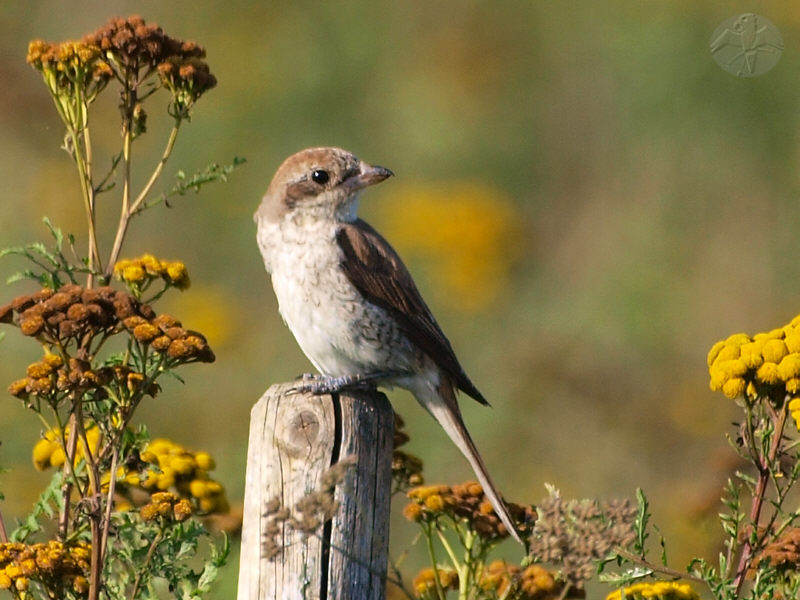 |
The female Red-backed Shrike (Rotrückenwürger oder Neuntöter, Lanius collurio) shows no red at all. Notice the light banding aside the breast (not tit!).
|
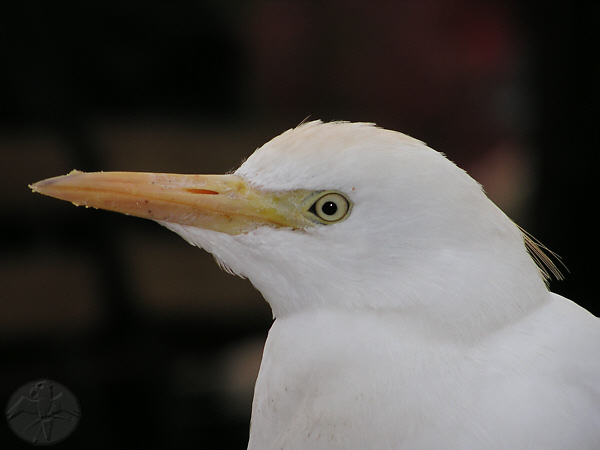 |
Cattle Egrets (Kuhreiher, Bubulcus ibis) are neofaunistic elements over here, with their origin probably in escaped zoo birds. This one actually was shot in a zoo. Though unclipped and abled to go his own ways, it liked all the bird feeding people around the fastfood stands at the zoo way to much, to make a get away.
|
 |
Not to be confused with the Cattle Egret is the Great White Egret (Silberreiher, Casmerodius albus). It is much much larger, about the same size as the Blue Heron (below). It's also of neofaunistic character to my vicinity even though, it got here without the aid of man. Over the past three years I was able to watch them on regular basis. First an exceptional view, the sensation has cooled down a bit now. However, I still like to look at them, but to photograph them is an other matter, as they are easily spooked and take to flight at well over 100m distance!
{3} [1000mm, F8, 1/400s]
|

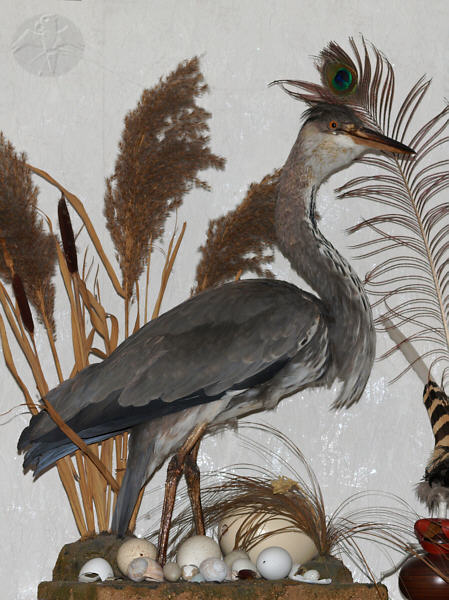
The Blue Heron (Graureiher, Ardea cinerea) is our native species. It is a common bird, at least for this size.
About 35 years ago it was still possible or at least not completely illegal, to hunt Herons. Hunting them, specially with Peregrine Falcons, was considered the sport of the Kings and the Nobles since the Middle Ages!
I remember that my father was eager to try this very feat, but with his Goshawk. Though, he was affraid his precious Hawk might get seriously injured by the Herons beak, he had to try nevertheless, because of the upper class status this sort of things always had and certainly because it had never been done before (with Goshawk instead of Falcons) or at least not for a long long time. So, I was fortunate enough to witness my fathers Goshawk catch a very few Herons! And she really went through with flying colors! I guess, this wasn't done ever since!?
All hawked Herons but one, could be released again later. Though, some had to be nursed a few days until fit to go. One Heron was hit so hard that he didn't made it and went into my fathers body mount collection instead. The mount is still in existence and shown here in the upper right position.
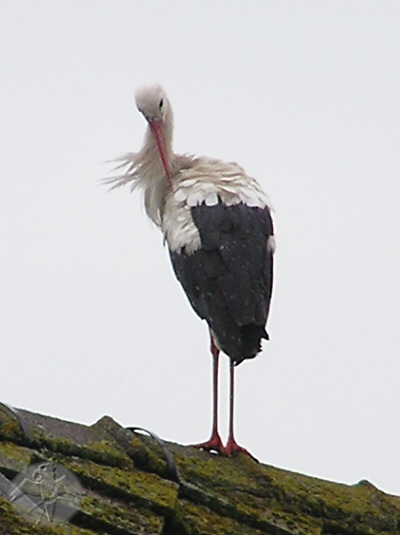 On a rainy summers day the White Stork (Weißstorch, Ciconia ciconia) aside had a rest on my neighbours roof, from where he could watch all the pastures to the south.
For half an hour he was busy with straightening and cleaning his feathers back into shape, befor he finaly went down, stalking small critters in the aforementioned pastures. The photo is one year old now but, just yesterday evening I took an other photo of one, doing just that, in the same place. Storks are not so numerous anymore as they used to be 30 years ago, but I think they will get through anyways.
On a rainy summers day the White Stork (Weißstorch, Ciconia ciconia) aside had a rest on my neighbours roof, from where he could watch all the pastures to the south.
For half an hour he was busy with straightening and cleaning his feathers back into shape, befor he finaly went down, stalking small critters in the aforementioned pastures. The photo is one year old now but, just yesterday evening I took an other photo of one, doing just that, in the same place. Storks are not so numerous anymore as they used to be 30 years ago, but I think they will get through anyways.
The pictured fellow is unique insofar as he doesn't wear a ring of any sort. Over here bird "protecting" folks go crazy about putting a ring on every bird they can get hold of. Actionism ← which I doubt that it's of any use at all! For example, migratory behavior and flown routes are long known for every species. But, if people can put a ring on a bird, they think they have protected mother nature as a whole again 
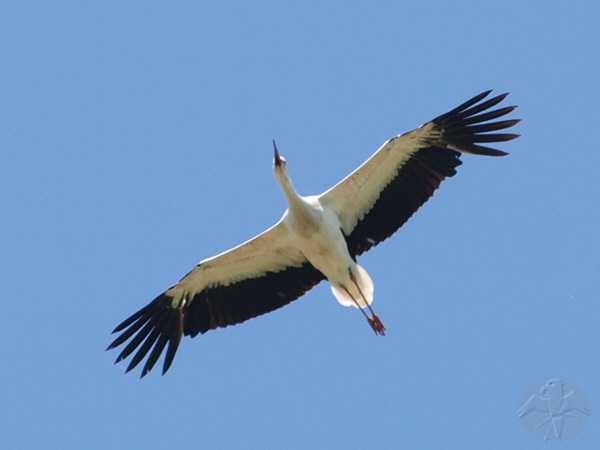 What might be needed indeed is more respect for mother nature and it's creatures and the knowledge of ones own place in the whole grid, plus a genaral understanding of all the processes which rule the planet. These are all explain- or at least understandable by laws of physics, chemistry, biology. Given some good teachers you can get all in a single file with Geology/Paleontology. These later professions are also able to open peoples eyes and minds in other ways. Because the general distorted viewpoint of man is herewith set back in the correct time frame: Nature's – where a billion years can mean absolutely nothing and a few hours the whole world ...
|


The Black Stork (Schwarzstorch, Ciconia nigra) is almost extinct but I'll show one anyways, of course. Sadly I noticed him a little to late when he was flying over and got him only at great distance; pics are therefore 100% crops. But hey, I am pround I identified him and snapped away, and can so prove its existence.
{9} [600mm, F6.3, 1/640s]
|
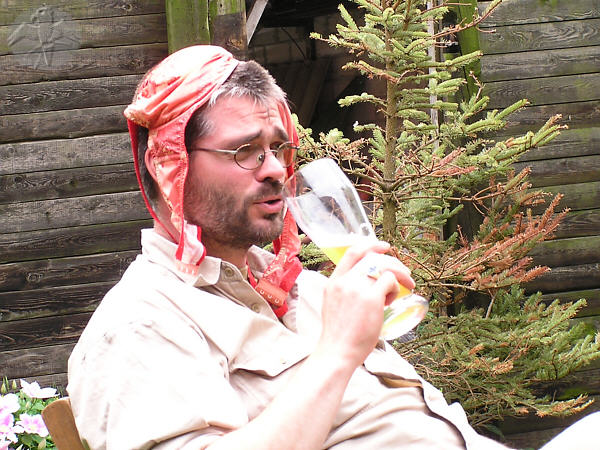
Okay guys! Now! Try to relax ... and get over it!
|
